The Dingbat Approach

This month at the Stiletto Gang we’ve been talking about transitions and how moving to a new stage of life can affect writing. But I have to admit that as I sat down to think about the topic all I found myself pondering was the actual literal transitions of writing. One of the primary tasks of a writer is to choose not just what to include, but what to leave out. There are very few (if any?) novels that are told in one long continuous stream of time. And every time the writer skips over the trip to the bathroom or the drive from point A to point B she must choose how to indicate that transition.

Chapter 1
The Hard, Fast Break

Some writers like to make each new location or time switch a new chapter.  It’s concrete. It’s self explanatory. And pretty hard for the reader to get confused. But others like to the soft break.

***

In the typography world those little asterisks are called dingbats. They come in all shapes and sizes and can be themed to the text. Karen Harris Tully‘s series The Faarian Chronicles is a sci-fi young adult adventure centered on a planet that was settled by Amazon warriors of Earth. This gives the featured culture of the planet a Greek historical context (and strong feminist heroines) and makes the transition dingbats of the omega symbol fun and appropriate.

blank space

The softest break of all is the extra space.  As a graphic designer, I’m not in favor of these. It’s far too easy, in a longer work, for the extra space to get buried at the end of the page. Then what does the designer do? Force the text to start lower down on the next page? That looks awkward and can lead to confusion on the part of the reader. Not to mention the fact that coding these for the e-readers and online is more than a little bit difficult.  In other words, if I see these in a book I immediately think the writer is a jerk who doesn’t care about how much extra work their designer has to do.

im_a_designer_not_a_screwdriver_poster-rcc06134967db4a5d92aae443a039d1e6_wvx_8byvr_512Foolishly, when I first got into the publishing biz I found myself incredibly surprised when my layout manuscript came back for proofing that the designer had kept all of my transitions as I had typed them. Somehow I genuinely thought that I would send off my MS and somewhere out in New York someone would do something clever with my transitions.  I was kind of sad.  I didn’t want to manage my own transitions – I wanted someone else to do all the work for me.

Which when I think about it, is about what I think about life transitions as well. How unfortunate that there’s no magic wand or designer to outsource those problems to.  I guess I’m just going to put my lifestyle setting on “dingbat” and see what I get.


Originally published at the Stiletto Gang on 09.14.16

Market Research

As I have been exploring the question “Who are you like?” this month, I’ve also been exploring what other books in my genres look like.  This is sometimes gratifying on the base level of my fonts are so much better than yours and also sometimes mystifying on the level 51rIIiVsAeLof why are there so many bared midriffs in contemporary fantasy?  On the topic of midriffs, and purely for example’s sake, I’ll put the cover of Shifting Jock in Love here.  The cover is obviously… uh… fully functional, because I can’t stop staring at the uh… weight lifting bar.  Now that we’ve covered that topic (no, we haven’t covered anything?), let me move on to my point.
Market research, which is what I call shopping and (gently) making fun of book covers over a glass of wine, is important.  It’s hard to review my own book cover submissions if I don’t know what the trends are.  Not that trends should inform every decision, but I like to know how far out of the current I’m swimming. In addition to finding the occasional good idea that I could be copying, I also find really interesting authors.  Research shows that most people buy books based on word of mouth, but in this online age, that can’t ALWAYS be true.  From Facebook to google ads, to the wonders of Amazon, we get a lot of recommendations about authors and books online.  And without a person to ask, readers are stuck trying to answer “so who are they like” question based on the marketing surrounding the book.  But as we all learned in grade school, you can’t always judge a book by it’s cover.

One great resource I’ve found in my wading around the internet is a great website – www.literature-map.com  Simply type in an author you like and it will produce of an animated cloud of similar authors aka a handy new To Be Read list.  And you can click on the question mark in the corner if you want to add authors to the database to improve results.  And now if you’ll excuse me, I’m going to go enjoy a little more market research and a Riesling.


Originally published on 8/24/16 at the Stiletto Gang

Who are you like?

One of the most common questions a writer hears is: Who are you like?  In other words, what (famous, more talented, richer, that I would have heard of) author are you like?  Of course, as authors we would always like to respond – I am like no one! I am a unique snowflake of infinite genius!  Bow down before my staggering work of novelistic achievement!  Possibly at this point is where we also start investing in a parrot, flowing robes, and a pencil thin moustache to twirl.  I’m not saying all authors would go full Disney villain. Clearly, the eyebrows and make-up require a more high-maintenance lifestyle than most of us are cut out for.  I’m just saying, nobody likes to think of themselves, as “just like” somebody else.

However, temper-tantrums and eyeliner aside, it is a useful question.  It does let people know where they should look for you in the library and where you fall on their reader spectrum.  For the record, I usually answer this question with – Janet Evanovich.  My series Carrie Mae Mysteries is female centered spy series, with plenty of hunks, humor, and huge action scenes.  However, I also write in another genre – contemporary fantasy.  I write modern day fairy tales about fairies, vampires, and what happens when a mermaid meets a SEAL.

Writing in multiple genres used to be very “not done” because the publishing houses found it hard to market.  The prevailing wisdom was that readers don’t read multiple genres (uh… say what?), Self-publishing has opened the door for authors to write whatever their unique snowflake heart’s desire, but it’s still a risk, and a challenge for those doing the marketing, to figure out what to say to the question – who do you write like?

I guess for now, I’ll have to go with this answer – I write like my fingers are fire with sheer greatness and my mascara is totally, totally on point.

***

Originally posted on 8.10.16 at The Stilettog Gang


Cranking (Toddler) Tunes

Many things change after having a baby.  And I have to say that one of the things that I’m the most sad to see change is the amount of music I listen to.  Baby nap times seem to encompass the whole dang day! I used to have iTunes running almost constantly.  Not that it wasn’t a battle with my husband over what to listen to.  No, I don’t want more Phish.  And there’s only so much hip-hop and Grateful Dead I can listen to before going insane. (Yes, my husband is a hippy with a secret love of 90’s R&B.  He compensates for this deficiency by being ruggedly handsome and having the miraculous ability to open jars and kill countless spiders.)

The interesting thing is that, aside from the specific bands, where my husband I deviate in our musical tastes is an actual love of music.  He loves music.  Phish, Dave Matthews, the Allman Brothers, and the Grateful Dead all have one thing common.  OK, take a toke and make that two things – they’re jam bands.  I hate jam bands.  It’s just giant swaths of useless music that take away from the important thing – the lyrics.  I love the words. (Surprised?  Probably not.)  For me, music is like poetry with half the pretentiousness and way more shake-your-bootiliciousness.  And I like to play it ALL the time particularly when I’m working.  I find that music helps put me in the zone for writing and for design.

But with an in-home office and a baby, it’s become a lot more difficult to crank the tunes through the work day.  I was excited when the baby hit two and it became easier to send her to daycare/babysitting and there’s only one nap to contend with, but it has also meant that she’s tons more verbal.  With a toddler in the house, I don’t feel quite so comfortable cranking up a few of the songs I love, like Don’t Shoot Me Santa by The Killers.  I am perfectly prepared to explain that boys have a penis and some people are in wheelchairs and sometimes boys marry boys and girls marry girls.  But… I am not at all prepared to explain why Santa is shooting that guy in the song.  I’m pretty sure I see headphones in my future.


***

Originally posted on 7.27.16 at The Stiletto Gang

The Red String of My Mind

In the cop shows, whenever the intrepid detective (Watching the Detectives, Elvis Costello) is working on the massive conspiracy that killed her mother/lover/those six girls we never met, but who really give our character a reason to act, the case is always shown as pictures (Pictures of You, The Cure) tacked up and connected by red string. I don’t know what set designer came up with the red string, but they ought to get royalties. It’s so common that if I worked at a craft store and someone bought red string I’d think they were a serial killer, a cop thrown off the force for refusing to quit the case, or a grandmother of toddlers stocking up for Christmas. I bring this up for the reason that it is a fitting visual for the song lyric littered wasteland (Teenage Wasteland, The Who) that is my brain.

Whenever I have a story noodling around in my head, but haven’t moved it to the level of having an outline, my natural writing style is to pick out scenes that I want to write, type them up, and save each scene to it’s own word document. As you can imagine, this creates a number of random word documents that might be hard to keep track of. But I have a system, most often I’ll name the document the song lyric associated with it. As a book grows, frequently these scenes become chapters, and those document names become chapter titles. Which is why the original table of contents for Bulletproof Mascara, the first of my Carrie Mae Mystery novels, read more like a playlist than serious literary subtitles. Sadly, editor made me change most of them – now they simply hint at the songs they reference. Apparently, the only people more uptight that literary rights lawyers or music rights lawyers. But you can still rock out to the Bulletproof Mascara playlist simply by visiting my youtube page (youtube.com/CarrieMaeMysteries) – please enjoy the musical stylings of David Bowie, James Brown, Simon & Garfunkel, Tech9, Morcheeba, and (of course) more.

Originally posted on 7/13/16 at The Stiletto Gang

Wild Waters Release

Wednesday saw the release of my new novella – Wild Waters!! This is my first time doing true romance (sex scenes – eep!) and I’m very excited for everyone to get a chance to read it!

Purchase Wild Waters at:
>>Amazon(Kindle) >>Smashwords(all digital versions)
Or enter to win a free copy through 6/26 >>HERE<<

WILD WATERS (with Sienna Lance)

His duty. Her secrets. The mission that brings them together will tear them apart.
In the steamy jungle of 1960’s era Vietnam, when a team of Navy SEALs are brought together with a pair of reporters, no one is prepared for the explosive secrets their encounter will reveal. Lt. Ben Kolley, former WWII frogman, leads one of the first teams of Navy SEALs in 1968 Vietnam. His wild pack of soldiers have earned their reputations as “green ghosts” on the Mekong River and none is more elusive than Catch, the point-man with an uncanny sense of the water. The reporters, a bumbling drunken writer, and Kahele, a female photographer with a sharp mind, dark eyes, and an even darker secret are the first allowed to interview a SEAL team and both are intent on nailing their assignment. But neither Kahele or Catch are prepared to discover an attraction for each other that’s like nothing they’ve ever experienced. Soon, Catch is breaking all the rules to be with her, and Kahele finds herself entangled by a passion she’s never felt before. But for Ben, Kahele dredges up horrifying memories of an old mission – one where not all of his team returned. Can Kahele be trusted or is she the monster Ben fears? The clock is ticking, and soon all their lives may depend on Ben’s decisions. SEALs believe they can survive anything, but can they survive the truth?

My Toddler Works for James Patterson

My dad says he invented the skateboard.

He says that he had never before seen or heard of a skateboard when he put a plank on skate wheels. Of course, his invention went no further than a backyard of summer fun, but he still likes to claim his invention when some youth sails by on a long board.

Well, now I feel his pain.  James Patterson, Mr. Prolific himself, is in the process of releasing what he’s calling “Book Shots” — novella length works, penned with co-authors, that cost less than five dollars.

You have no idea how annoyed this makes me.

Because it was MY idea.  This month I’m releasing Wild Waters, a novella length paranormal romance (sex scenes!) story.  The genre is outside of my usual brand, but I thought the structure and topic were interesting (reporters, SEALs, Vietnam!). I also thought my readers might enjoy something at a lower price point, but in my style of writing.  I examined the options.  I had the thoughts.  I came up with the plan.

And then James Patterson stole it out of my brain!  How dare he use his larger amounts of money, time and fame to launch my idea!  It makes me want to march right over to his house and give him a toddler.  Let’s see how fast he can type then.  Toddlers should be like weights for jockeys.  If Vegas gambled on writer’s turning in manuscripts on time, I’m sure that they would have developed some sort of toddler distribution system by now.  Fortunately, for Mr. Patterson and for me, there’s plenty of room in this world for novella’s and writers of all kinds, with or without toddlers. Good luck to both of us with our tiny books.


Originally Published at the Stiletto Gang on 06.08.16

Now is the time…

Late in the month, it seems like almost everyone suddenly wakes up and realizes that the deadlines that seemed so very far away are now, like, almost here, man.  Cue panic.  Cue sudden uptick in workload for yours truly.  The problem is that I’m exactly like everyone else.  I’ve been noodling over several pieces of writing and now the deadline is like, almost here, man!

Now is when the marathon of writing becomes a sprint. Just how fast can fingers type?  We’re about to find out.

Now is also about the time when back pain and carpal tunnel set in.  Time to start juicing writers!  No, I mean literal juicing.  It’s important to stay hydrated – prevents muscle spasms.  Although, I personally prefer copious amounts of tea, liberally applied, at regular intervals.

Now is the time when the tiny proto-human you’ve been carefully nurturing like a hot house bloom looks up from a coloring book and says, “Sorry mom, work. Four more minutes.”  Gee, wonder where she got that?

Now is the time that my face looks like this:

stressed face

So wish me luck as I sprint to the end of the month.  And wish my family luck as they get abandoned for fake people that I made up.


Originally published on the Stiletto Gang 05.25.16

Personal Fitness

Originally published at the Stiletto Gang on 05.11.16

I’m going to let you in on a secret – writing is not for wussies. It’s for old people.

Or at least it makes you feel old. Carpal tunnel. Eye twitches and strains. Aching neck, sore back. The human body was not designed to spend hours sitting at a computer, and the hours compound into stiff muscles that have forgotten how to move. Walking into the kitchen after a prolonged bout of editing, I look like I’ve escaped from the neighborhood old-person jail… er… assisted living facility. I imagine that back when writers were churning out novels by quill and candlelight that it wasn’t any better. But at least back then we were likely to die by forty anyway and probably needed to worry more about childbirth and dental hygiene than whether or not our wrists were a tad achy.

I could trot out some line about suffering for my art, but the truth is, I do many things to combat the muscular stress of sitting and writing. First of all, I got married and had a kid. Although, maybe that wasn’t quite my intended outcome when I started down the aisle, it has to be said that nothing curtails long hours at a computer like a toddler. However, the things I intentionally do to keep myself from becoming Quasimodo include walking / jogging, stretching and keeping up on my martial arts training. And then I whine and complain until my husband gives me a neck rub. And then when all else fails I break down and pay for a massage.

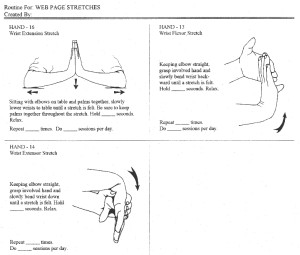
Below are the most common stretches I do for my wrists. These drawings were actually produced by one of my former employers – Visual Health Information. They produce drawings for physical therapists and others to give to patients. I have found all of these to be very helpful for my extended typing lifestyle.

wristhand1

Organizing My World(s)

An author’s job is not just to tell a story, but to decide how a story should be told. Is it better in first or third person? Is it told in one long march of words or are their chapters? We have to decide genre, tone and feeling. And once those decisions have been made an author must create and track the main plot of the story – the one that we struggle to capture in the blurb text on the back cover – as well as the sub-plots, underlying themes, and finally, the characters themselves.  All of those pieces require not just the ability to write, but also the ability to track information. Because, as any serious reader will tell you (sometimes at great length), consistency and details matter greatly to a well written book, and while we can rely on an editor for some items, they are only human and can only catch so much.  It is in an author’s best interest to provide the cleanest manuscript possible.

I’m currently working on two vastly different stories: the fourth Carrie Mae Mystery Glossed Cause and a Romance Horror novella Wild Waters.  Each story comes with an array of characters, research and plot twists that to be perfectly honest I can’t hold in my brain.  Possibly pre-production of a toddler I could have kept hold of all the details, but no longer. Now, to keep all my worlds organized, I must rely on a system of notes, plot outlines and spreadsheets.

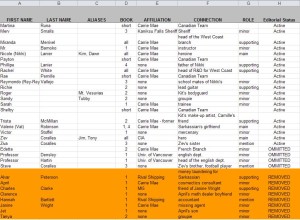
CM-characterlistFor the Carrie Mae books I track characters with a spread sheet that notes who they are (name, basic role, job or company) and also what book they have appeared in or if they have been deleted or omitted from a book.  I also have a rather extensive style sheet that helps me keep track of how certain things, such as chapter headings are formatted and whether or not I’m consistently formatting things like “AK-47” and “INTERPOL” the same way over multiple books.

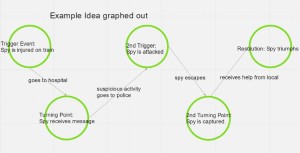
plot graphFor Wild Waters I’m writing in two different time periods – WWII and Vietnam ­– and they each use distinctive slang that I organize in a couple of basic lists.  There are also multiple character points of view and it is important to keep track of what characters know and when they know it, so that each plot point is revealed at the correct time. Tracking character arcs are more difficult and sometimes require multiple ways of visualizing.  I will frequently write out the plot from each characters point of view or I will graph it out on a virtual whiteboard, utilizing the main plot points.

There is no perfect system of course, and each author must work the way that works for them. But when examining a well-written book, I am frequently in awe, not just of the beautifully constructed words or strong turn of phrase, but the underlying construction of a book.  Sometimes, I find it amazing that any books get written at all.